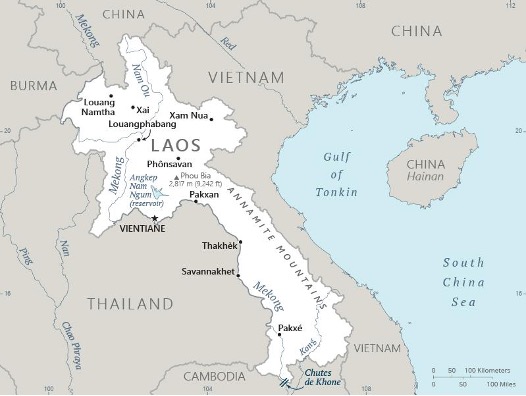
Laos is a landlocked country in Southeast Asia. The first Laotian state was Lan Xang, “Kingdom of the Million Elephants”, which reached its peak of power and prosperity under the reign of Setthathirath I (1548-71). In 1707, Lan Xang split into three rival kingdoms: Luang Prabang, Vientiane, and Champasak which became vassals of Siam (now Thailand) in 1779, after the Siamese army sacked and looted Vientiane. The Siamese annexed most of the Laotian territories, except for Luang Prabang, which remained a semi-autonomous kingdom under the Siamese protection.
In the late 19th century, Laos became a part of the French colonial empire in Indochina, and the three Laotian kingdoms were united under a single protectorate establishing the borders of the modern state of Laos. After World War II, Laos became a constitutional monarchy under King Sisavang Vong and in 1953, it gained full independence from France. Soon after, during Vietnam War (1954-75) it was split into two sides: the Royal Lao Government, which was allied with the United States and South Vietnam, and the Pathet Lao, which was allied with North Vietnam and the Soviet Union. In 1975, the Pathet Lao emerged victorious and established the Lao People’s Democratic Republic. The new communist government, led by the Lao People’s Revolutionary Party (LPRP), aligned itself with Vietnam and the Soviet bloc and imposed a harsh regime of collectivization, political repression, and isolation from the outside world. In the 1980s, Laos began to introduce some economic and political reforms, however, the LPRP remained the sole legal political party and maintained tight control over the media, the judiciary, and the civil society. Human rights violations, corruption, and poverty continued to be major challenges for Laos.
Since the 1990s, Laos has experienced rapid economic growth, driven by the exploitation of its natural resources, such as hydropower, minerals, and timber, and the development of tourism, agriculture, and manufacturing. However, the economic development has also brought social and environmental problems, such as income inequality, rural-urban migration, ethnic conflicts, land disputes, deforestation, and pollution. Laos still remains one of the least developed and most aid-dependent countries in the world.
Lao (official), French, English, various ethnic languages
MAJOR RELIGIONS
Buddhist 64.7%, Christian 1.7%, none 31.4%, other/not stated 2.1% (2015 est.)
TIME DIFFERENCE
UTC+7
GOVERNMENT TYPE
Communist state
ECONOMY
Lower middle-income, Socialist Southeast Asian economy; one of the fastest growing economies; declining but still high poverty; natural resource rich; new anticorruption efforts; already high and growing public debt
Electricity, gold, rubber, fertilizers, paper (2022)
EXPORTS – PARTNERS
Thailand 35%, China 29%, Vietnam 10%, Australia 4%, (2022)
IMPORTS
Refined petroleum, gold, electrical machinery, raw sugar, plastic products (2022)
IMPORTS – PARTNERS
Thailand 56%, China 26%, Vietnam 8%, Malaysia 3% (2022)
EXCHAGE RATES
Kip (LAK) per US Dollar (USD) 21,816 (2024)
TELEPHONE CODE
+856
EMERGENCY PHONES
Ambulance: 195; Police: 191
ELECTRICITY/VOLTAGE
230 V / 50 Hz / plug types: A, B, C, E, F
MAJOR SPORTS
Soccer, sepak takraw (kick volleyball), muay lao (martial art)
TIPPING GUIDELINES
Tipping is not customary except in tourist-oriented restaurants where 10% of the bill is appreciated, but only if a service charge has not already been added. Tour guides and day-long drivers expect USD 10-15 per day for a gratuity. Tip hotel staff USD 2-3 per day for their service.
SOUVENIRS
Hand-woven silk or cotton sarongs, gold and gemstone jewelry, wood carvings, spices, hill tribe bags
CULTURAL PRACTICES
Laos is a country with a rich and diverse culture that reflects its ethnic and geographic diversity. Laos has many cultural practices that are important to follow when visiting or interacting with the local people. Here are some of them:
Greet people respectfully. The traditional Lao greeting is called the nop, which involves pressing your palms together and bowing your head slightly. The person of lower status offers the nop first, and the person of higher status returns it. You can also say sabai dee, which means hello.
Dress modestly, especially when visiting temples and sacred sites. Cover your shoulders and knees, and avoid wearing anything too tight or revealing. Also take off your shoes when entering someone’s home or a temple.
Use your right hand when eating or passing things to others. The left hand is considered unclean, as it is used for toilet duties. You should also eat with your hands, as this is the traditional way of enjoying Lao cuisine. Sticky rice is the staple food, and you can use it to scoop up other dishes.
Respect elders and monks. You should always show deference and politeness to those who are older or more senior than you. You should never touch a monk or his belongings, especially if you are a woman. You should also avoid pointing your feet at anyone, especially a monk or a Buddha image, as this is considered very rude.
Avoid open displays of affection. Lao culture is very conservative and modest, and public kissing or hugging is frowned upon. You should also avoid any topics that are too personal or sensitive, such as politics, religion, or sex.
Keep your cool and smile. Lao people value calmness and harmony, and do not like confrontation or anger. You should never lose your temper or raise your voice, as this will make you lose face and respect. Instead, you should smile and be patient, even if things are not going your way.
Ask permission before taking pictures. Always respect the privacy and dignity of the people and places you are photographing. Do not take pictures of monks during their prayers, or of people who are bathing or working. You should also not take pictures of military or government buildings, as this may cause trouble.
Participate in festivals and ceremonies. Lao people celebrate many festivals throughout the year, which are often related to the agricultural cycle, the lunar calendar, or the Buddhist events. These festivals are a great opportunity to learn about the culture and traditions of Laos, and to join in the fun and festivities. Always follow the etiquette and customs of the festival, and be respectful of the local beliefs and practices.
Shop responsibly and ethically. Always bargain politely and fairly, and not try to get the lowest price possible. Avoid buying any products that are made from endangered animals or plants, or that are of cultural or religious significance. Support the local artisans and craftsmen, and buy souvenirs that are authentic and ethical.
MAJOR TOURIST DESTINATIONS
Luang Prabang is the former royal capital and a UNESCO World Heritage Site. It is famous for its ancient temples, colonial architecture, and cultural heritage. You can visit the Royal Palace Museum, the Wat Xieng Thong temple, the Kuang Si Falls, and the night market.
Vientiane is the capital and largest city of Laos. It is located on the banks of the Mekong River and has a relaxed atmosphere. You can see the Pha That Luang, the golden stupa and national symbol of Laos, the Patuxai, the victory gate and monument, the Wat Si Saket, the oldest temple in the city, and the Buddha Park, a sculpture park with over 200 statues of Buddha and Hindu gods.
Wat Phou is an ancient Khmer temple complex and a UNESCO World Heritage Site. It is located in the Champasak province and dates back to the 5th century. It was originally dedicated to Shiva, but later became a Buddhist site. You can admire the impressive architecture, carvings, and sculptures of the temple, as well as the stunning views of the Mekong River valley.
Si Phan Don is a group of islands in the Mekong River, also known as the Four Thousand Islands. It is a popular destination for nature lovers and adventure seekers. You can enjoy the scenic views of the river, the waterfalls, the rice fields, and the fishing villages. You can also spot the rare Irrawaddy dolphins, kayak, bike, or relax in a hammock.
Plain of Jars is a mysterious archaeological site in the Xieng Khouang province. It consists of thousands of stone jars scattered across the landscape. The origin and purpose of the jars are still unknown, but some theories suggest they were used for burial or ritual ceremonies. You can explore the different sites and learn more about the history and legends of the jars.
TRADITIONAL CUISINE
Lao cuisine is a rich and diverse culinary tradition that reflects the ethnic and geographic diversity of Laos. Lao cuisine is influenced by various neighboring countries, especially Thailand, Vietnam, and China, but also has its own distinctive flavors and dishes. Some of the traditional dishes of Lao cuisine are:
Sticky rice is the staple food of Laos and is served at most meals at all times of day. Sticky rice is made of glutinous rice that is steamed in a bamboo basket, which makes the rice become sticky and easy to eat with your hands. Sticky rice can be eaten with various sauces, such as an aubergine or spicy tomato sauce, or with other dishes, such as larb or papaya salad.
Larb is a salad made of seasoned minced meat, with toasted brown rice, shallots and chillies. Larb is considered the national dish of Laos and is enjoyed as a simple, hearty meal for lunch or dinner. The meat can be chicken, beef, pork, duck or fish, and is usually fried with fish sauce and seasoned with lime juice, cilantro and mint. Larb is often served with sticky rice and/or lettuce cups.
Papaya salad is a spicy and refreshing salad made of shredded green papaya, tomatoes, garlic, peanuts, dried shrimp, fish sauce, lime juice and chillies. Papaya salad is a popular snack or side dish in Laos and is often eaten with sticky rice and grilled meat or fish. Papaya salad is also known as tam mak hoong in Lao or som tam in Thai.
Khao soi Luang Prabang is a tomato and meat noodle soup that originates from the northern city of Luang Prabang. Khao soi Luang Prabang is made of flat rice noodles, minced pork, fermented soy beans and a thick tomato-based broth. The soup is lightly seasoned and has a rich and savory flavor. Khao soi Luang Prabang is usually eaten for breakfast, but can also be enjoyed throughout the day.
Kaipen is a snack made of dried river weed, lightly salted and topped with sesame seeds. Kaipen is made of river weeds that are harvested from the Mekong River, dried in the sun, pressed into thin sheets, seasoned and flash fried to make them crispy. Kaipen is rich in vitamins and minerals and is similar to Japanese nori. Kaipen can be eaten on its own or with a spicy dipping sauce.
Khao poon is a coconut curry soup with vermicelli noodles. It is made of chicken and chicken broth, vermicelli rice noodles, coconut milk and red curry paste, which gives the soup a bright reddish orange color. The soup also contains several aromatic herbs, such as lemongrass, lime leaves and galangal. Khao poon is a spicy and creamy soup that is often served with fresh vegetables and herbs.
CLIMATE
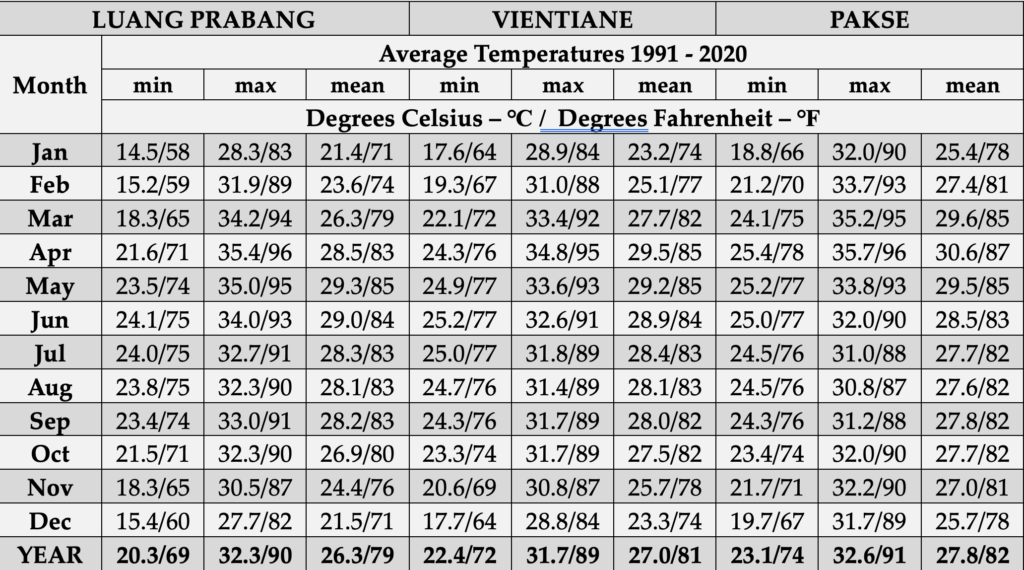
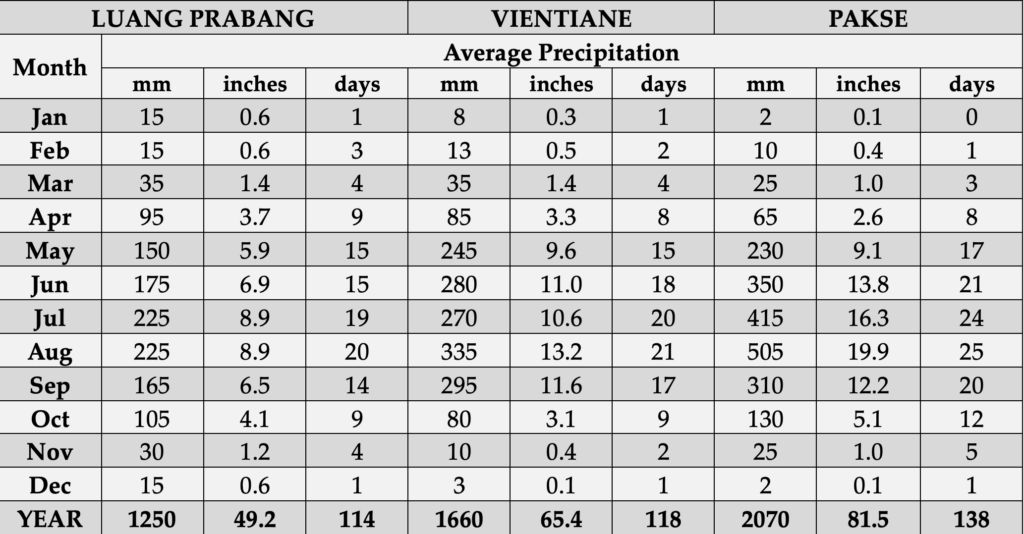
Laos has a tropical climate with two distinct seasons: the rainy season from May to October and the dry season from November to April. The climate is influenced by the monsoons, the altitude, and the geography of the country. The average annual temperature ranges from 20°C to 27°C, depending on the region and the season. The average annual rainfall varies from 1,200 mm to 3,000 mm, with the highest amounts in the south and the mountains. Laos is prone to floods and droughts, as well as typhoons that can bring heavy rains and winds in the late summer and early autumn.
The rainy season is characterized by high humidity and frequent showers, especially in the afternoon and evening. The rain can sometimes be torrential and cause flash floods and landslides. The temperature during the rainy season is usually warm, ranging from 25°C to 33°C. The rain also brings lush greenery and abundant crops to the country. The rainy season is the best time to visit Laos for those who want to see the waterfalls, the rice fields, and the wildlife .
The dry season is divided into two sub-seasons: the cool dry season from November to February and the hot dry season from March to April. The cool dry season is the most pleasant time to visit Laos, as the temperature is mild, ranging from 15°C to 25°C, and the humidity is low. The skies are clear and sunny, and the air is fresh and crisp. The cool dry season is also the peak tourist season, as many festivals and events take place during this time, such as the Lao New Year, the Elephant Festival, and the Boat Racing Festival.
The hot dry season is the most challenging time to visit Laos, as the temperature can soar up to 40°C and the humidity can reach 90%. The air is dusty and smoky, as many farmers burn their fields to prepare for the next planting season. The hot dry season is also the time when the water levels of the rivers and lakes are low, making some activities, such as boating and kayaking, difficult or impossible. The hot dry season is the best time to visit Laos for those who want to avoid the crowds and enjoy the lower prices.
PASSPORT/VISA REQUIREMENTS
A passport valid for at least six months following your date of entry with at least two blank pages for immigration stamps.
A visa to enter Laos, unless you are from an ASEAN member country or from South Korea, Mongolia, Japan, Luxemburg, Switzerland, and Russia that are exempted from visa requirement for certain periods of time.
Most visitors of other nationalities that are not visa-exempt may obtain a visa on arrival valid for 30 days for a fee at multiple ports of entry to the country. It can be extended for another 30 days at the immigration office in Vientiane. The visa fee varies depending on your nationality, ranging from 30 USD to 45 USD. To apply for a visa on arrival, you need to prepare your passport, two recent passport-sized photos, a completed visa application form, and the visa fee in cash (USD or Thai Baht). For those who don’t have a photo, there is service at the customs for scanning the photo from the passport for a fee (USD 1-2). There will be additional charges for the visa if you arrive between 6am and 8am, on a weekend, or on a national holiday.
Nationals of a number of countries, mostly from Africa and Middle East, are ineligible to obtain a visa on arrival. They can only obtain a visa on arrival if they are traveling on an official visit and are holding an official letter of guarantee issued by the Ministry of Foreign Affairs of Laos.
eVisa for Laos is available to citizens of all countries except countries whose citizens are ineligible for visa on arrival. To apply, you need to fill out an online application form, upload a passport photo and a copy of your passport, and pay the visa fee with a debit or credit card. You will receive an email confirmation and an eVisa approval letter, which you need to print out and present at the port of entry. The eVisa is valid for 60 days from the date of issue and allows a single entry of up to 30 days
You might have to show your hotel reservation and return ticket (not always if you are crossing the border by land). It is a good idea to have a travel plan from a travel agent to avoid any issues. You are not allowed to bring in or take out the local currency. If you have more than USD 2,000 or equivalent in foreign currency, you need to declare it at customs. Some nationalities (from certain African countries like Sudan, Somalia, etc. or Asian countries like Bangladesh, Afghanistan, Pakistan, etc.) may be required to pay a security deposit (from USD 500) at customs, which will be refunded on the day of departure. Otherwise, they will not be allowed to enter.
VACCINATIONS
The CDC and WHO recommend the following vaccinations for Laos: hepatitis A, hepatitis B, typhoid, cholera, yellow fever, Japanese encephalitis, rabies, meningitis, polio, measles, mumps and rubella (MMR), Tdap (tetanus, diphtheria and pertussis), chickenpox, shingles, pneumonia, COVID-19, and influenza.
WHAT TO PACK
Clothing
Lightweight, light-colored, and breathable clothing to cope with the heat and humidity.
A light raincoat or umbrella if traveling in the rainy season.
A swimsuit and a towel for swimming in waterfalls or rivers.
A long scarf or a sarong to wrap around yourself when needed. You should also remove your shoes before entering a temple or a private home.
Hygiene
Some toiletries and accessories that can help you stay clean and healthy during your trip.
Sunscreen, insect repellent, hand sanitizer, a microfiber travel towel, a reusable water bottle with a filter, and some snacks.
Some basic medicines for common ailments, such as painkillers, antihistamines, antidiarrheals, and rehydration salts.
Activities
Some electronics and entertainment items that can help you enjoy your trip and capture your memories.
Phone, charger, power bank, earphones, camera, laptop or tablet, e-reader or books.
Comfortable sandals or shoes that are easy to take on and off.
Insect repellent, a hat, sunglasses, and a camera for exploring the countryside or the islands.
Security
An anti-theft backpack that has hidden zippers and slash-proof material. Some padlocks for bags and a neck wallet for passport, cash, credit cards, and phone.
Use a VPN service when connecting to public WiFi sources, as they may not be secure.
Be aware of some of the common scams and dangers that tourists may encounter, such as taxi overcharging, fake money, or pickpocketing. Like anywhere in the world, always be alert and cautious when traveling in Laos.