Myanmar (Burma) is a Southeast Asian country that has been ruled by various ancient kingdoms, such as the Pagan, the Ava, and the Shan, since the 1st century BC. Buddhism became the dominant religion of the region.
The country was colonized by the British in the 19th century, and became part of British India. The British exploited the resources and people of Myanmar, and created ethnic divisions. Myanmar gained independence in 1948, after fighting against the Japanese in World War II with the help of the Allies. Myanmar’s democracy was overthrown by a military coup in 1962, and the country was ruled by a socialist dictatorship for 26 years. The dictatorship isolated Myanmar from the world, and caused poverty and oppression. In 1988, a pro-democracy uprising was crushed by the army, and a new military junta took power. The junta held a rigged election in 1990, which was won by the National League for Democracy (NLD), led by Aung San Suu Kyi, the daughter of the independence hero Aung San. The junta ignored the results and put Aung San Suu Kyi under house arrest.
In 2010, the junta held another election, which was also rigged, and formed a civilian government led by a former general. The government initiated some reforms, such as releasing political prisoners, allowing media freedom, and pursuing peace talks with ethnic groups. Aung San Suu Kyi was freed and participated in the 2012 by-elections, which the NLD won. In 2015, the NLD won a landslide victory in the first free and fair election since 1990, and Aung San Suu Kyi became the de facto leader of the country. In 2020, the NLD won another landslide victory in the general election, which the military and its allies rejected and claimed fraud. On February 1, 2021, the military staged a coup and detained Aung San Suu Kyi and other NLD leaders. The military declared a state of emergency and appointed the army chief as the head of a new ruling body. The coup sparked a massive wave of resistance and civil disobedience by the people, who demanded the restoration of democracy and the release of the detained leaders. The protesters were met with violence and repression by the security forces, who killed hundreds of people and arrested thousands. The protesters also formed a shadow government and a people’s defense force to counter the military. The coup also reignited some of the ethnic conflicts in the country, as some of the ethnic armed groups sided with the protesters and clashed with the military. The situation remains volatile and uncertain, as the military and the pro-democracy movement are locked in a deadly standoff, with no signs of dialogue or compromise.
Buddhist 89.8%, Christian 6.2%, Muslim 2.3%, other 1.6% (2019)
TIME DIFFERENCE
UTC+6.5
GOVERNMENT TYPE
Previously, parliamentary republic
ECONOMY
Prior to the February 2021 military coup, massive decline in poverty, rapid economic growth, and improving social welfare; underdevelopment, climate change, and unequal investment threaten progress and sustainability planning; since coup, foreign assistance has ceased from most funding sources
REAL GDP PER CAPITA
USD 5,300 (2024 est.)
INDUSTRIES
Agricultural processing; wood and wood products; copper, tin, tungsten, iron; cement, construction materials; pharmaceuticals; fertilizer; oil and natural gas; garments; jade and gems
Note: Depending on where you are, the numbers might vary. Ask your local tour guide for assistance if necessary. They will know how and where to make the call and get help.
ELECTRICITY/VOLTAGE
230 V / 50 Hz / plug types: A, C, D, G, I
MAJOR SPORTS
Soccer, golf, lethwei (martial art), chinlone and sepak takraw (ball sports)
TIPPING GUIDELINES
Tipping is not a common practice, but guides and drivers do expect to be tipped. Tipping guides USD 2-5 per person per day is customary; drivers should receive USD 1-2 per day.
SOUVENIRS
Bamboo and lacquer items, silk, longyi sarongs, loose gem stones, jewelry, jade items, especially Buddha figures; marionettes
CULTURAL PRACTICES
are largely influenced by Theravada Buddhism, which is the dominant religion of the country. There are some dos and don’ts that visitors should be aware of when interacting with the local people and visiting the religious sites:
Greeting: The common way to greet someone in Myanmar is to bow slightly with the palms together in front of the chest, similar to the Indian namaste. This gesture is called anjali in Burmese, and it shows respect and politeness. A smile is also appreciated, as the Burmese are generally friendly and hospitable. A handshake is not the norm, especially between opposite sexes or with older people. It is better to wait for the other person to initiate a handshake, if they prefer. When addressing someone, it is polite to use the honorific U (for men) or Daw (for women) before their name, or to use their professional title, such as doctor or teacher.
Head and feet: The head is considered the most sacred part of the body, while the feet are considered the lowest and dirtiest. Therefore, it is rude to touch someone’s head, even as a friendly gesture, or to point or gesture with the feet. It is also disrespectful to step over someone or something, or to sit with the feet pointing at someone or a Buddha image. When sitting on the floor, it is advisable to tuck the feet under the body or to the side, and not to stretch the legs out.
Clothing: Myanmar is a conservative country, and visitors should dress modestly and respectfully, especially when visiting religious sites. Shorts, skirts, and dresses should cover the knees, and tops should cover the shoulders and chest. Tight or revealing clothes should be avoided. It is also customary to wear a longyi, a sarong-like cloth that wraps around the waist, instead of pants or skirts. Both men and women wear longyis, but with different patterns and styles. Wearing a longyi shows respect for the local culture and also provides comfort in the hot and humid climate.
Shoes: Shoes and socks should be removed before entering any religious site, such as a pagoda, a temple, or a monastery. This is a sign of reverence and cleanliness, as the shoes are considered dirty and unfit for the sacred space. Shoes should also be removed before entering someone’s home, unless the host indicates otherwise. It is polite to place the shoes neatly outside the door, and not to step on them or point at them with the feet.
Do not turn your back to a Buddha image or statue, or take a photo with it. Always face the Buddha image and bow slightly when passing by or leaving.
Do not touch or disturb a monk or a nun, or their belongings. Monks and nuns are highly revered in Myanmar, and they follow strict rules of conduct. Women should avoid any physical contact with monks, and men should also be careful not to touch them accidentally. If offering something to a monk or a nun, such as food or money, place it on a tray or on the ground, and not directly in their hands.
Do not eat or drink in front of a monk or a nun, or offer them food or drink after noon. Monks and nuns only eat two meals a day, and they abstain from eating or drinking anything after noon. It is considered rude and insensitive to eat or drink in their presence, or to tempt them with food or drink after their fasting time.
Do not display any signs of affection or intimacy in public, such as kissing, hugging, or holding hands. Myanmar is a conservative and traditional country, and public displays of affection are considered inappropriate and disrespectful, especially in religious sites. It is better to keep a respectful distance and behave modestly in public.
MAJOR TOURIST DESTINATIONS
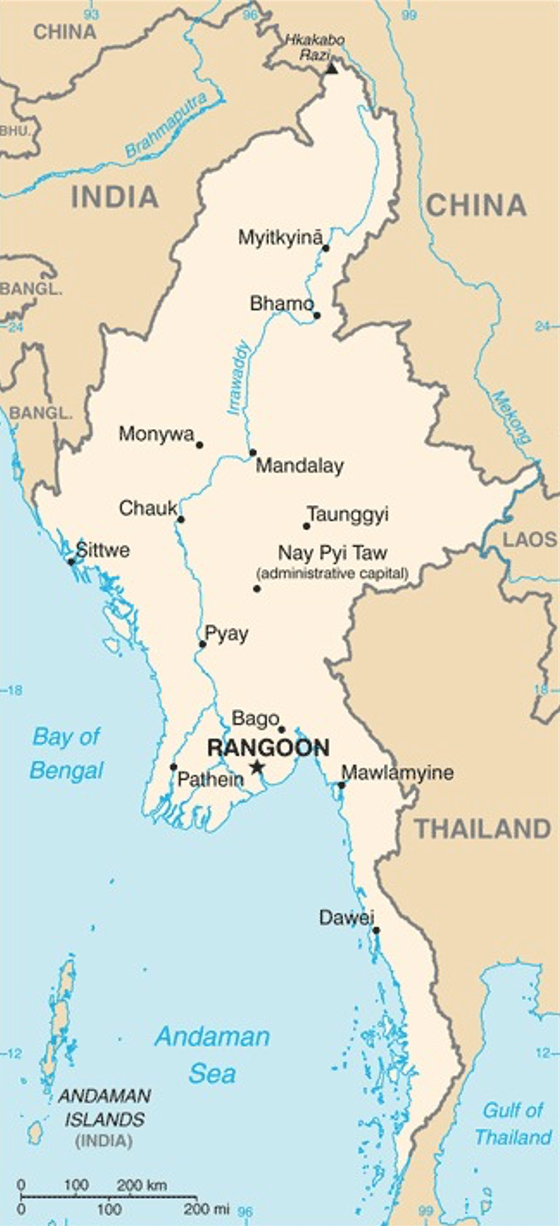
Yangon is the largest city and the former capital of Myanmar. It is known for its colonial architecture, bustling markets, and glistening temples. The most famous attraction is the Shwedagon Pagoda, a stunning gold-covered stupa that is considered the most sacred site in Myanmar. The pagoda is surrounded by hundreds of smaller temples, shrines, and statues, and attracts pilgrims and tourists alike. Other attractions include the Sule Pagoda, the Chaukhtatgyi Buddha, the Bogyoke Aung San Market, and the Kandawgyi Lake.
Bagan is an ancient city that was the capital of the Pagan Kingdom from the 9th to the 13th centuries. It is one of the most impressive archaeological sites in the world, with over 2,000 temples, pagodas, and monasteries scattered across a vast plain. Bagan is a UNESCO World Heritage Site, and a popular destination for hot air balloon rides, bike tours, and sunset views. Some of the most notable temples are the Ananda Temple, the Dhammayangyi Temple, the Shwesandaw Pagoda, and the Thatbyinnyu Temple.
Mandalay is the second-largest city and the last royal capital of Myanmar. It is a cultural and religious center, with many monasteries, pagodas, and palaces. Mandalay is also a hub for arts and crafts, such as woodcarving, silk weaving, and puppetry. Some of the main attractions are the Mandalay Hill, the Shwenandaw Monastery, the Kuthodaw Pagoda, the Mahamuni Pagoda, and the Mandalay Palace. The city is also a good base for exploring nearby attractions, such as the U Bein Bridge, the Mingun Pagoda, and the Inwa Ancient City.
Inle Lake is a large freshwater lake in the Shan State, and one of the most scenic and unique places in Myanmar. The lake is home to the Intha people, who live in stilt houses and floating villages, and are famous for their leg-rowing technique and floating gardens. The lake also hosts many temples, pagodas, and monasteries, such as the Phaung Daw Oo Pagoda, the Nga Phe Kyaung Monastery, and the Shwe Indein Pagoda. The lake is a popular destination for boat tours, cycling, hiking, and birdwatching.
Ngapali is a beach resort town on the Bay of Bengal, and one of the best places to relax and enjoy the sun, sand, and sea in Myanmar. It has a long stretch of white sandy beach, lined with palm trees and fishing boats. The water is clear and calm, and ideal for swimming, snorkeling, and kayaking. Ngapali also has a variety of hotels, restaurants, and spas, catering to different budgets and tastes. It is a great place to escape the crowds and experience the natural beauty and charm of Myanmar.
TRADITIONAL CUISINE
Myanmar has a rich and diverse cuisine, influenced by the flavors and techniques of its neighbors, such as India, China, and Thailand. Some of the traditional dishes of Myanmar are:
Mohinga is a fish-based soup with rice noodles, onion, hard-boiled egg, ginger, and various herbs. It is often considered the national dish of Myanmar, and is usually eaten for breakfast. It is served with crispy fritters, sliced eggs, and fish cakes, and garnished with chili flakes and coriander leaves.
Nan Gyi Thoke is a warm salad of thick rice noodles, chicken or beef curry, chili oil, chickpea powder, coriander, and shallots. It is also known as Mandalay Mont Di, and is a hearty and spicy dish.
Burmese Tofu is a type of tofu made from chickpeas or split peas, instead of soybeans. It can be eaten in different ways, such as fried, sliced, or molten. It can be served with a tamarind dip, a salad dressing, or a spicy noodle dish.
Burmese Biryani is a rice dish with chicken, beef, goat, lamb, fish, or prawns, cooked with various spices, such as turmeric, cumin, coriander, coconut milk, and saffron. It is similar to the Indian biryani, but with a milder flavor.
Shan Noodles is a noodle dish from the Shan ethnic group, who live in the eastern part of Myanmar. It consists of a chicken broth with marinated chicken pieces, sesame and garlic oil, and rice noodles. It is served with pickled vegetables, peanuts, and chives.
Tea Leaf Salad is made from fermented tea leaves, mixed with cabbage, tomatoes, fried beans, peanuts, sesame seeds, garlic, and lime juice. It is a popular snack and appetizer, and has a sour and crunchy taste.
Coconut Milk Noodles is a noodle dish made from coconut milk, chicken curry, and wheat noodles. It is also known as Ohn No Khao Swè, and is a creamy and rich dish.
Mone Lone Yay Paw is a dessert made from glutinous rice flour, coconut, and palm sugar. It is shaped into balls and boiled in water, then served with shredded coconut. It is a festive dish, usually eaten during the Thingyan water festival.
CLIMATE
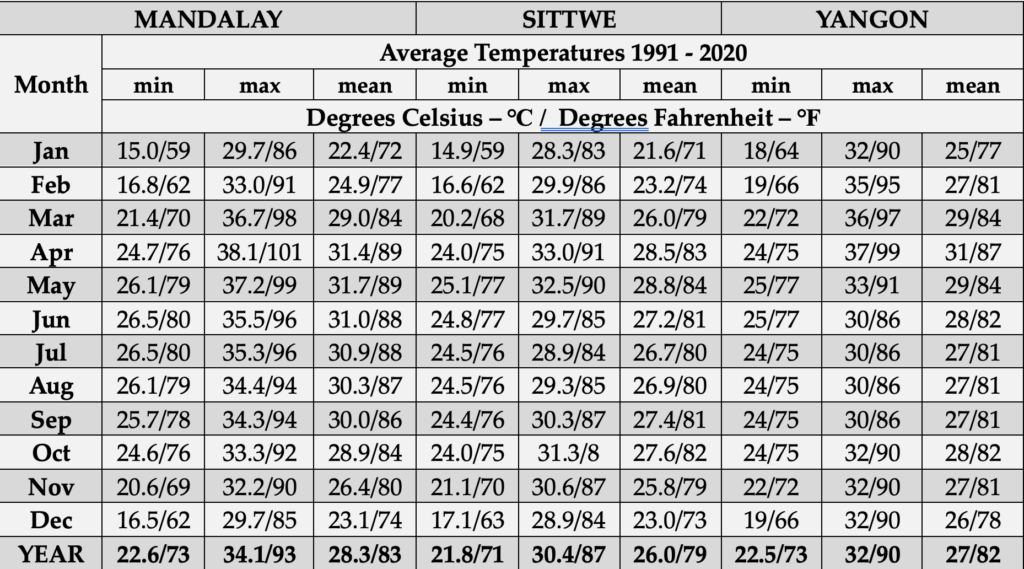
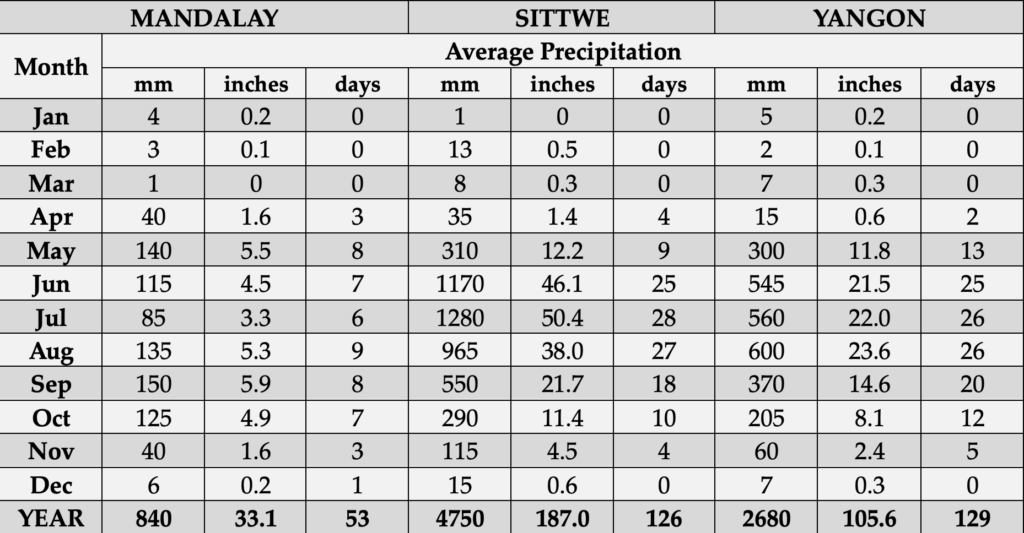
Myanmar has a tropical to sub-tropical monsoon climate with three distinct seasons: a cool winter from November to February, a hot summer season in March and April, and a rainy season from May to October, dominated by the southwest monsoon. The climate varies depending on location and elevation. The coastal and delta regions have a humid and warm climate, while the central dry zone has a semi-arid and hot climate. The hilly and mountainous regions have a temperate and cool climate, with some areas experiencing snowfall in the winter.
The average annual temperature in Myanmar is 27.4 °C (81.3 °F), with the highest temperature of 37.5 °C (99.5 °F) in April and the lowest temperature of 16.7 °C (62.1 °F) in January. The average annual rainfall in Myanmar is 2,783.3 mm (109.58 in), with the highest rainfall of 605.8 mm (23.85 in) in July and the lowest rainfall of 0.4 mm (0.02 in) in January. The rainy season accounts for about 80% of the total rainfall, and the coastal and hilly regions receive more rain than the central and northern regions³.
The climate of Myanmar has a significant impact on the natural resources, agriculture, biodiversity, and human health of the country. The climate also affects the tourism industry, as visitors tend to avoid the rainy season and travel in the dry season, which runs between November and April, with peak inflows occurring between December and February. The climate of Myanmar is also vulnerable to the effects of climate change, such as extreme weather events, sea level rise, flooding, and drought. These effects pose serious challenges and risks to the development and sustainability of the country.
PASSPORT/VISA REQUIREMENTS
A passport valid for at least six months following your date of intended departure from Myanmar with at least one blank page for immigration stamps.
A visa to enter Myanmar, unless you are from one of ASEAN member countries that are exempted from visa requirement for certain periods of time. There are different types of visas for Myanmar, depending on your purpose of travel, such as tourist visa, business visa, social visa, transit visa, etc. The most common type of visa for travelers is the tourist visa, which allows you to stay in Myanmar for 28 days within three months of issue. You can apply for a tourist visa online (eVisa) or at the embassy or consulate of Myanmar in your country.
The eVisa is an online visa application system that allows you to apply for a tourist visa or a business visa from anywhere in the world. You can apply for an eVisa through the official website of the Myanmar government. You will need to fill in the online form, upload a passport-sized photo, pay the visa fee of USD 50 for tourist visa or USD 70 for business visa, and receive an approval letter by email within three days. You will need to print out the approval letter and show it to the immigration officers at the port of entry.
The visa on arrival is a service that allows you to obtain a visa at the port of entry in Myanmar, without applying in advance. However, this service is currently only available for nationals who are traveling for business or transit purposes, and from certain countries, such as Australia, Canada, China, India, Japan, Singapore, UK, USA, etc. You will need to complete a visa application form and provide two passport-sized photos, a valid passport, a return ticket, and a visa fee of USD 50 for business visa or USD 20 for transit visa. You can apply for a visa on arrival at the Yangon, Mandalay, or Nay Pyi Taw international airports.
The visa in advance is a service that allows you to obtain a visa from the embassy or consulate of Myanmar in your country, before you travel. You will need to complete a visa application form and provide two passport-sized photos, a valid passport, a driver’s license, a proof of travel, and a visa fee. You will need to allow three to five working days for visa processing if applying at the embassy.
VACCINATIONS
An International Certificate of Vaccination for yellow fever is required for travelers arriving from countries with a risk of yellow fever transmission and for travelers having transited through the airport of a country with risk of yellow fever transmission.
WHAT TO PACK
Clothing
Lightweight, light-colored, and breathable clothing to cope with the heat and humidity.
A light raincoat or umbrella if traveling in the rainy season.
A swimsuit and a towel for swimming in the sea, waterfalls or rivers.
A long scarf or a sarong to wrap around yourself when needed. You should also remove your shoes before entering a temple or a private home.
Hygiene
Some toiletries and accessories that can help you stay clean and healthy during your trip.
Sunscreen, insect repellent, hand sanitizer, a microfiber travel towel, a reusable water bottle with a filter, and some snacks.
Some basic medicines for common ailments, such as painkillers, antihistamines, antidiarrheals, and rehydration salts.
Activities
Some electronics and entertainment items that can help you enjoy your trip and capture your memories.
Phone, charger, power bank, earphones, camera, laptop or tablet, e-reader or books.
Comfortable sandals or shoes that are easy to take on and off.
Insect repellent, a hat, sunglasses, and a camera for exploring the countryside or the islands.
Security
An anti-theft backpack that has hidden zippers and slash-proof material. Some padlocks for bags and a neck wallet for passport, cash, credit cards, and phone.
Use a VPN service when connecting to public WiFi sources, as they may not be secure.
Be aware of some of the common scams and dangers that tourists may encounter, such as taxi overcharging, fake money, or pick-pocketing. Like anywhere in the world, always be alert and cautious when traveling in Myanmar.